


1. What is PPWR?
PPWR (Packaging and Packaging Waste Regulation) is the European Union’s new regulation on packaging and packaging waste management, formally adopted as EU Regulation 2025/40.
PPWR aims to reduce packaging waste, promote a circular economy, and establish more harmonized requirements for packaging across the EU market. The regulation entered into force on February 11, 2025, and began to apply on August 12, 2026.
2. Which Businesses Will Be Affected by PPWR?
PPWR applies to all types of packaging placed on the EU market, including:
- Packaging for products exported to the EU
- Industrial packaging
- Transport packaging
- E-commerce packaging
- Packaging for electronic, automotive, and mechanical components
This means Vietnamese companies exporting goods to Europe, as well as businesses supplying products to global supply chains connected to the EU market, may be affected by PPWR.
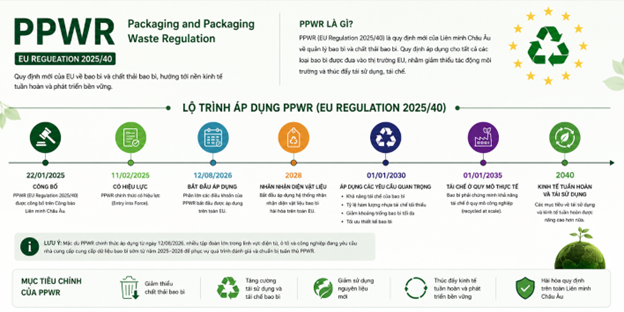
3. Key PPWR Timeline
-
Date
Key Milestone
22 January 2025
PPWR (EU Regulation 2025/40) published in the Official Journal of the European Union
11 February 2025
PPWR officially entered into force
12 August 2026
Most PPWR provisions begin to apply across the EU
2028
Harmonized packaging material identification labeling begins to be introduced
1 January 2030
Several important requirements take effect, including recyclability, minimum recycled content, and restrictions on unnecessary empty space
2035
Packaging must demonstrate recyclability at scale
2040
Further targets for reuse and circularity will be introduced
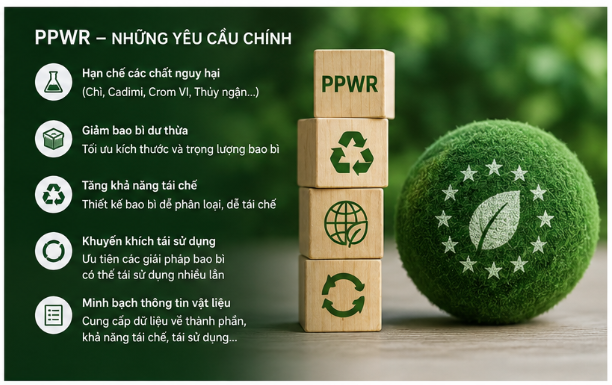
4. Key PPWR Requirements for Packaging
4.1 Restriction of Hazardous Substances
PPWR requires hazardous substances in packaging to be controlled.
This includes:
- Lead (Pb)
- Cadmium (Cd)
- Hexavalent chromium (Cr6+)
- Mercury (Hg)
The total concentration must remain within the limits specified by EU regulations.
4.2 Reducing Excessive Packaging
One of the key objectives of PPWR is to reduce packaging waste.
Businesses are expected to:
- Design packaging appropriately for the product
- Minimize unnecessary empty space
- Optimize packaging dimensions
These measures can help reduce material consumption as well as transportation costs.
4.3 Increasing Recyclability
Packaging should be designed to:
- Facilitate sorting
- Facilitate recycling
- Minimize the use of materials that are difficult to process
The future direction of packaging is increasingly focused on environmentally responsible solutions that support the circular economy.
4.4 Promoting Reuse
PPWR encourages the use of packaging that:
- Can be reused multiple times
- Has a long service life
- Helps reduce waste generation
This is one reason reusable packaging solutions such as Danpla and reusable plastic trays are receiving increasing attention.
4.5 Greater Transparency of Material Information
Suppliers may be required to provide information relating to:
- Material composition
- Packaging weight
- Recyclability
- Reusability
These data are often compiled into packaging assessment reports or documentation required by customers.
Source: TSK - VN
News other
- The Secret Behind Corrugated Boxes: How a Simple Fluted Structure Creates Extraordinary Strength (27/06/2026)
- What is Yin-Yang Carton Box? (25/04/2026)
- Expert Insights on Key Development Trends for Vietnam’s Printing Industry in 2026 Based on Data (23/01/2026)
- Summary of Key Developments in the Global and Vietnamese Paper Industry in 2025 (31/12/2025)
- Digital Printing Technology in the Packaging Industry – A New Step for Modern Production (24/11/2025)
- Vietnam Print Pack - International Printing & Packaging Industry Exhibition (15/09/2025)
- E-FLUTE CORRUGATED PACKAGING CARDBOARD PRODUCTS (15/08/2025)
- CARTON BOXES FOR FRUITS (24/06/2025)
- 10-layer Carton Box (29/05/2025)